Tuesday, August 10, 2010

What are the disability listings, and why are they important?

Aside from financial considerations and work history, the other significant component of making an application for disability benefits is being able to prove the existence of a disability. “Meeting a listing” is widely regarded as the most straightforward means by which a disability is established. The “listings” are contained within the Social Security Blue Book and may be found here.

Essentially, the Blue Book is a collection of medical maladies that are categorized by body system (cardiovascular, digestive, etc.) Within each body system is a set of descriptions of medical concerns that may occur within that system, which could rationally lead a person experiencing these concerns to be declared disabled. Many of the maladies are multi-faceted, and require that multiple criteria be met. Some of these criteria are objective (cardiac left ventricular ejection fraction), and some are more subjective (marked restriction of activities of daily living).

Submitting a medical record that is able to provably demonstrate that a listing is met will make securing disability benefits substantially more straightforward, at least regarding medical concerns. Even in cases where a record does clearly demonstrate the meeting of Blue Book criteria, further development is done by the SSA for the purposes of evaluating the relative reliability of the existing medical records, as well as getting an independent opinion about the Claimant’s medical condition. In many cases, these opinions are not favorable to Claimants and for this reason, it is recommended to have a strong treatment relationship with one’s own physician.

Monday, August 9, 2010

Seniors Taking Early Retirement in Record Numbers

2.74 million people filed for Social Security Benefits in 2009, and the nation's unemployment is at 9.5%. This larger-than-ever draw against Social Security has created a budgetary shortfall that is projected to become the de rigeur as baby boomers move further toward retirement.

In an article released today by the Associated Press, it was noted that nearly 3 out of 4 people filing for benefits are doing so under the "early retirement" Social Security program, which notably contains benefits at a reduced level. This is a pretty clear indicator of one or more of a few things. Either individuals are scared that benefits design will reduce benefits (or increase the age for full eligibility) and they want to grandfather in, that the funds will not be available when they need them (probably unlikely in the short term), or that aged individuals who want to work are being laid off or cannot find work, and are willing to accept reduced Social Security benefits in order to alleviate the problem. Either way, the economic climate has created a ripple effect that is being felt even by all.

For more information about Social Security, Contact Thomas O'Brien at Feiler & Associates.

Thursday, August 5, 2010

Annual SocSec Trustees Report Released - Health Reform Implicated

The Social Security Board of Trustees released their annual report on Thursday, August 5, 2010 and the financial outlook for Social Security remains substantially unchanged. Highlights include the following:
  • The trust fund is estimated to exhaust in 2037, at which time the tax revenues being collected are expected to fund 78% of benefits.
  • The disability trust fund is expected to exhaust in 2018, which will require a re-allocation of funds to support continued benefits payouts.
  • In 2015 and thereafter, tax revenues will fall below program costs. This estimate now is one year sooner than described in last year's report.
  • During 2009 Social Security paid benefits of $675 billion dollars to 53 million beneficiaries.
  • The cost to administer Social Security ($6.2 billion dollars) was only 0.9% of total expenditures.
This forth bullet point is somewhat significant in the sense that, when viewed without scrutiny, it conveys a level of efficiency that most people do not experience in dealing with Social Security. In fact, I would submit to my readership that this number will continue to drop in the years to come, and not due to increase efficiency (though certainly hope springs eternal). This is an exercise in using statistics to tell a certain story.

Any mathematical percentage contains by necessity a numerator (in this case administrative expenditures) and a denominator (in this case total expenditures). One can lower the ratio by either decreasing the numerator, which in this case would indicate cutbacks in overhead, or one can lower the ratio by increasing the denominator (in this case total benefit payouts). Since we are still very much on the front edge of the baby boomer retirement cycle, benefit payout amounts will rise at increasing rates for the foreseeable future, meaning that administrative expenses, which operate as a lagging indicator, will probably fall. For this reason, it is important that we, as concerned citizens, ensure that we understand movement on both sides of this ratio.

Proponents of the recently passed Healthcare Reform bill are citing the savings that the bill is projected to create (via efficiency measures and IT improvements) should change the somewhat disheartening profile of Social Security funding for the positive. The true impact of the reform bill will not likely be felt in the near future due to the extensive changes that it will require, and the litigation that is likely to happen concurrently with its implementation.

Tuesday, August 3, 2010

Proving Disability in SSI and RSDI Cases

To be found disabled, you must be unable to do any substantial work because of your medical condition(s), and your medical condition(s) must have lasted, or be expected to last, at least 1 year, or be expected to result in your death. (see the Social Security website)

One of the most common questions that claimants have regarding their disability cases is how to prove their disability most effectively. At hearings, my admonition to clients and their supporting witnesses is to always tell the truth, but do so in the light most sympathetic to their cause. However, in the interest in resolving cases at a point earlier than a hearing, the biggest difference-maker in proving disability is the level to which medical records may convince an adjudicator of one's disability.

To that end, here are my cornerstones of medical evidence. Of course income and financial means will often bear on the quality of medical care (and as such medical records) available, but these should always be in the back of a claimant's mind as they interact with their caregivers. Failure to meet the standards herein may not doom a case to failure, but success in meeting these standards will certainly make proving disability a more clear-cut affair.

Strength of Opinion - The most vigorous opinion regarding a claimant's disability should come from their own doctor. This can often be summarized in a letter of disability or an RFC (residual functional capacity) report that the claimant's physician may fill out, but it should also be a recurring thread in treatment records. Notations and recommendations that the claimant must curtail daily activities, and notations of specific life-limiting symptoms from the condition or the treatment are very helpful in examining a case.

Continuity of Care - Another helpful feature that can help cases succeed is demonstrable continuity of care. If a claimant has seen a physician for the entire course of their illness, there is an implied level of credibility that may be inferred, especially where symptoms worsen. Continuity of care may be established through regular treating physicians, or in the cases of indigent persons who cannot privately source and schedule care, it may take the form of ER records. Regular visits to the ER for emergency care related to a claimant's illness can convey a level of continuity of symptoms that may be convincing as well. This is not to suggest that claimants should visit the ER for every minor medical symptom, but in the cases of true medical emergencies, EMTALA will require that the hospital treat a patient, regardless of factors such as insurance coverage, etc.

Number of Opinions - Most people seek a second opinion when dealing with medical challenges. In disability cases, many diseases that claimants experience are specialized to a particular body system. As a result of this, it is very helpful not only for a patient's primary care doctor to opine on a heart condition (for example), but also to seek opinion from their cardiologist. Certainly the admonitions regarding continuity of care, and strength of opinion noted above bear on the inclusion of these records in case evidence, but ultimately, the more professional, provable, and unbiased opinions that may be offered on a claimant's behalf, the more provable their case becomes.

No Interfering Opinions - The previous points represent ideals that patients should seek when building their record of disability. This final point represents an ideal to be avoided. In interacting with the physicians that treat them, claimant's should make every effort to avoid behavior that could cause their treating physicians to doubt their symptoms or word. Two major classes of such damaging opinions are of particular concern: malingering and substance abuse. Malingering is the fabricating or exaggerating the symptoms of mental or physical disorders for a variety of secondary gain, in this case the gain might be prescriptions, drug benefits, or even continued treatment. Malingering can cause additional challenges to a case because the testimony upon which a claimant should most desire to rest on is the indirect testimony made my their physician records. If those records do not support disability, or create doubt as to its existence, cases become much more complex. Allegations of substance abuse are are much more directly damaging to a case. Though this is a very complex issue that cannot be fully addressed in a note such as this, it is important to note that Social Security will look at the impact that the abuse has on a given medical condition, and may disregard that condition when evaluating a claim if it believes that ceasing the abuse of the substance will cause that condition to improve.

In summary, with regard to claiming disability, it is important to view medical records as claimant testimony, and do everything to ensure that medical records operate as case support, rather than create additional obstacles to overcome.

Monday, August 2, 2010

Gender Wage Disparity is Quantifiable through Social Security Disabiity Payouts

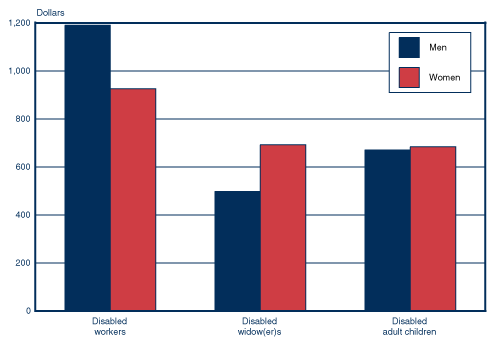
A significant graph was published in the Social Security Annual Statistical Report this year. Not only does it provide a quick average of monthly payments made to disabled workers and their families, it also provides a quick look at the disparity in actual earnings between men and women.

This is demonstrated in two places. First, it may be seen in disabled worker payouts (based on their earnings), where the men's payments were approximately 25% greater than the benefits paid to women, and secondly in widow(er)s' benefits, where men's benefits were significantly less due to the payment being based on their wives contributions.

In a 2009 report titled Women's Earnings in 2008, the U.S. Labor Department reported women's median wages to be 79.9% of men's. It would seem that biological and social factors are large contributors to this disparity since the report found that women who never married earned 94.2% of their unmarried male counterparts' earnings which demonstrates a much smaller differential.

Since the average disabled worker is 53 years old, it becomes obvious that this metric is a lagging indicator of wage disparity, and it will be interesting to track how much this gap will close in years to come.

From The Social Security Statistical Report:

"The average monthly benefit for disabled-worker beneficiaries is higher than that paid to disabled widow(er)s or disabled adult children. The reason for the difference is that disabled workers receive 100 percent of the primary insurance amount (PIA), compared with 71.5 percent for disabled widow(er)s and 50 percent for disabled adult children (if the worker is disabled or retired) or 75 percent (if the worker is deceased).

Because men have traditionally had higher earnings than women, their monthly benefit is higher. This is most obvious in the disabled-worker group. Benefits for disabled widow(er)s and disabled adult children are dependents' benefits, so their monthly benefit is a function of the worker's earnings. Therefore, a disabled widow's average benefit tends to be higher than that of a disabled widower because a male worker's earnings are higher than a female worker's. Benefit amounts are about the same for men and women in the disabled adult children group."


Friday, July 30, 2010

Announcement of a New Coalition to Save Social Security

StrengthenSocialSecurity.org is a group of more than 50 organizations that have banded together to decry benefit cuts to Social Security. Though their component organizations are diffuse in ideology and goals, they have assembled a list of principles that includes the idea that Social Security does not affect the deficit and should not be reduced to lower the deficit, that it should not contain a means test, that benefits should not be reduced, and that age requirements should not be increased.

They also appear to make some more politically charged suggestions that those who are disadvantaged should be given more, and that privatization should not occur. Though there are individuals who may disagree with the ideals espoused by some of the member organizations, and perhaps may even disagree with some of the tenets included in their guiding principles, it is great to see that there appears to be a push by some clout-bearing (read -monied) organizations to address this important issue, and hopefully help hold our Senate and Congress accountable to a greater degree than we as individuals can.

This site contains a number of Social Security myths and the explanations behind their debunking. It is a worthwhile read, and though was clearly written from a politically motivated position, it contains information worth exploring further.


Thursday, July 22, 2010

How far back can I look? Back Pay in SSI vs. RSDI Cases (Click Image to Increase Size)


For applicants and a representatives, it is wise to consider the amount of back benefits that a beneficiary may obtain based on the date of application as well as the alleged onset date. It is also vital to be aware of when a claimant's insured status runs, since amendment of the alleged onset date frequently occurs at the hearing level. Just the difference of one day can mean significant differences in insurance available to the claimant, not to mention their monthly benefit payment.


This image (c) Thomas C. O'Brien